GitOps for Hybrid and Multi-Cloud Delivery: Practitioners Perspectives on Scaling Kubernetes
Heba Eid


Last week at Tech Show London, we joined 15,000 engineering professionals to learn and share the latest in DevOps, Cloud & AI Infrastructure, Security, and more. We were excited to host a panel at the DevOps Live stage to discuss building GitOps for Hybrid and Multi-Cloud. In this blog, we will share key learnings and insights from these industry leaders.
Most platform teams didn't set out to build a hybrid or multi-cloud environment. They got there incrementally — a cloud migration that never fully finished, a compliance requirement that kept certain workloads on-prem, or an acquisition that brought a different stack into the mix. The result is the same: multiple environments to manage, inconsistent deployment patterns across teams, and pipelines that were never designed to handle the complexity they now face.
Kubernetes helps, but it doesn't solve this on its own. The flexibility that makes Kubernetes powerful also means every team makes different choices about how to use it. Add in the pressure to move fast, stay compliant, and keep developers productive without burying them in infrastructure concerns — and platform teams end up stretched thin managing tooling instead of enabling the business.
We sat down with three practitioners who run Kubernetes and GitOps in production — across healthcare, cybersecurity insurance, and our very own CEO, Hong Wang. The panelists shared their experience with adopting and operating GitOps at scale.
Here's what came out of that conversation.
GitOps for Hybrid and Multi-Cloud Delivery: Patterns, Trade-offs, and Lessons Learned
The panelists
Krzysztof Jonaszko, Product Owner at Dentsply Sirona
Yousef Alam, Sr. Staff Engineer at Cowbell.
Hong Wang, Argo Project creator and CEO of Akuity.
Moderated by Eddie Webbinaro, Solutions Engineering, Akuity.
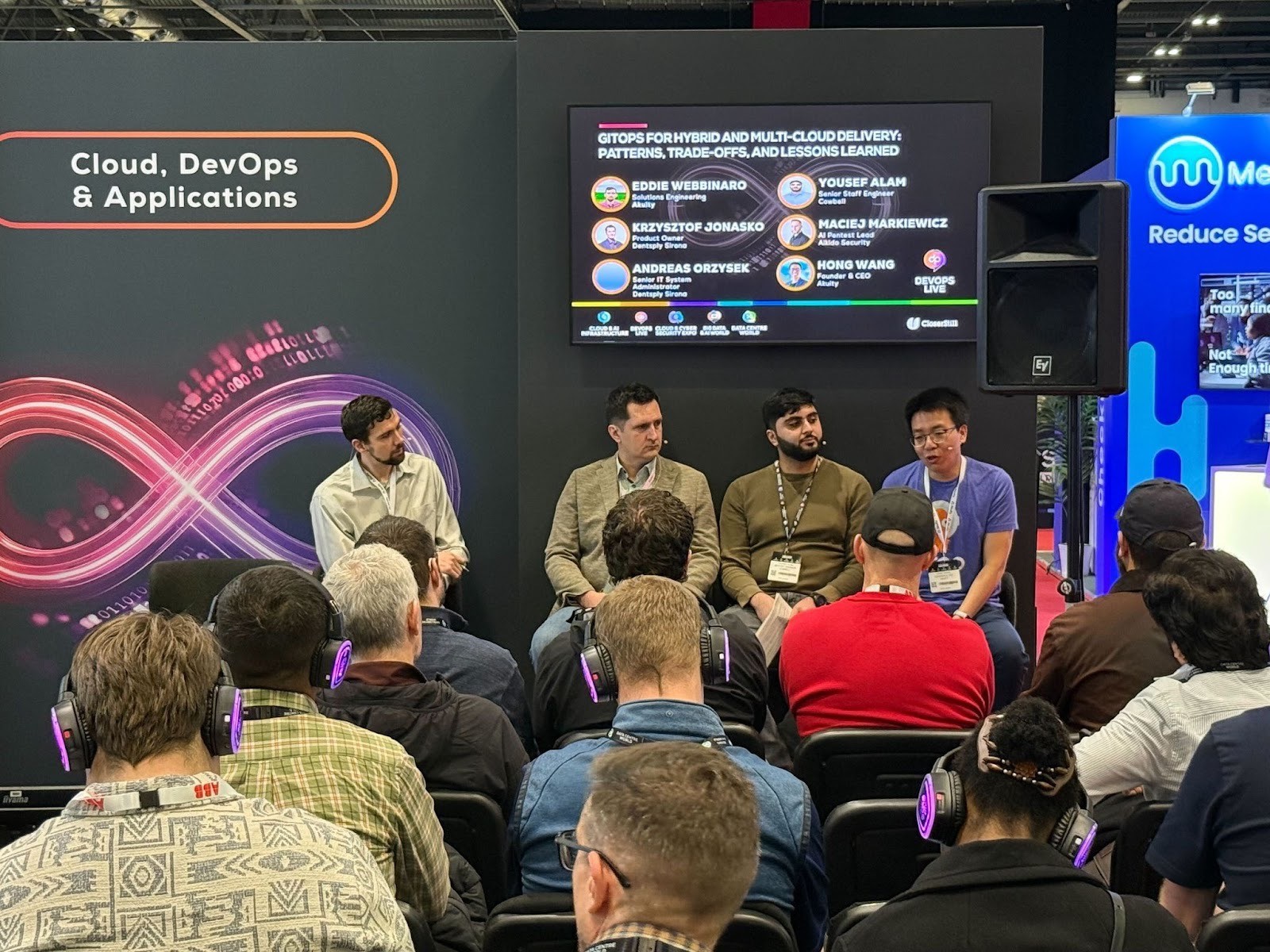
DevOps Live London, 2026: GitOps Multicloud Delivery Panel
1. Tooling sprawl is the hidden tax on every Kubernetes deployment
Kubernetes is flexible by design. The problem is that flexibility leads teams to stitch together many tools — each solving one narrow problem — into pipelines that are brittle by nature.
"You end up with so many different tools that each have their own little silo. You tie them together through your pipeline, and that pipeline becomes very fragile and prone to breaking." — Yousef Alam
The pipeline holding your tools together often becomes more of a liability than any individual tool in it.
2. At global scale, standardization matters more than optimization
Krzysztof's team at Dentsply Sirona deploys across multiple continents in a regulated industry. The technical challenges are secondary to the operational ones — consistency across regions, audit trails, and knowing the state of every environment at any point in time.
In regulated environments, GitOps earns its keep not just through automation, but through the auditability and drift detection that comes built in.
3. Reliability is the metric that actually moves the business
Yousef's team at Cowbell reduced customer-facing incidents by 80–90% after moving away from custom pipeline scripts and adopting Argo CD.
"When we had our super fragile pipelines with custom scripts inside of them, shifting over to Akuity Argo CD, we were able to drop somewhere between 80–90% of our customer-facing incidents purely just because our pipelines weren't breaking in the middle of complex deployments," — Yousef Alam
Krzysztof echoes the same sentiment. According to him, a developer should be confident enough deploying applicaitions on a Friday evening; otherwise, there’s a problem with the platform.
DORA metrics are useful internally, but the number your business stakeholders care about is how often your platform causes customer-facing issues.
4. Don't build what already exists
"Find a paradigm that's generally well accepted and stick to it. It may not be 100% for your organization, but it'll increase velocity much more than trying to build out a custom solution that almost works." — Yousef Alam
Unless you're operating at a scale that genuinely demands custom tooling, adopting established patterns — and committing to them — will move faster than building your own.
The 10% gap between a standard solution and your ideal one costs far less than building and maintaining a custom solution.
5. Developers want things to work — not access for its own sake
There's a constant debate about how much Kubernetes to expose to developers. Hong's view: the answer varies by org, but visibility is non-negotiable. Developers need to understand what's happening to their services, even if they don't manage the infrastructure directly.
"Engineers don't care about Kubernetes. They want to close their Jira ticket, ship a product, and move on." — Yousef Alam
Abstract the complexity, but never abstract the visibility.
6. In the AI era, GitOps becomes more important, not less
The panel's AI take was grounded. Near-term, plain-English runbooks and AI-assisted incident response are already shifting work left out of engineering and into the hands of product and support teams.
Longer term, Hong's view was structural:
"In the AI era, GitOps becomes more foundational. Everything will be code, everything will be declarative, and everything will be managed that way." — Hong Wang
If AI agents are going to ship code faster, you need an auditable, declarative system managing how that code gets deployed. GitOps is that system.
The contract between intent and infrastructure that GitOps provides matters whether the intent comes from a human engineer or an AI agent.
Watch the Full Conversation
The panel goes much deeper: specific tooling decisions, war stories from production, and a look at where GitOps is headed by 2030.
If you want to dig into any of these topics further, get in touch or try Akuity for free.
