The Promotion Layer GitOps Was Missing: The Rise of Kargo
Jesse Suen

GitOps promised a better way to deploy software. And for the most part, it delivered. Argo CD enabled teams to move their manifests into Git, and get reconciliation, auditability, and drift detection out of the box. But one problem remained largely unsolved: how do you move code safely from one stage to the next?
The answer, for most teams, has been a collection of CI pipelines, custom scripts, and manual approvals loosely held together. CI tools were built for synchronous, short-lived tasks. Continuous deployment, on the other hand, is asynchronous, multi-stage, and approval-gated. Forcing one to do the other's job creates exactly the kind of fragile, opaque system GitOps was supposed to replace.
Kargo was built to fill that gap. It adds multi-stage, GitOps-native continuous promotion to the ecosystem, sitting alongside Argo CD to handle what happens after your manifests hit Git. With KubeCon EU 2026 approaching, we thought we’d step back and look at the growth of the Kargo ecosystem over the past year: the community behind it, the teams running it in production, and where it is headed.
The Problem Kargo Solves
The failure mode of classic pipelines is not hard to diagnose. They are linear, stateless, and designed to run once. They do not reconcile. They do not clean up after themselves. They give you no reliable answer to the question every platform team eventually needs to answer: what is actually deployed, and where?
Johannes Sonner, Technical Product Manager at Deutsche Telekom, described it clearly during a recent GitOps Monthly session. Pointing to one of his team's pipeline run histories, he said: "Honestly, no one knows what is deployed." Some jobs had run two or three times. Others had been rolled back. The pipeline offered no way to know the current state of anything.
Kargo addresses this by giving teams a purpose-built promotion model. Artifacts move through defined stages as freight: a bundle that ties together a container image, a Git commit, and config values. Each stage can have verification attached, pulling metrics from your monitoring stack to confirm a deployment is healthy before anything is promoted further. Rendered manifests go back into Git, making the exact state of every environment auditable and reviewable before it ever reaches a cluster.
With Kargo, platform teams get a consistent deployment model across all their services, with policies and validation built into the pipeline rather than bolted on. Developers get set-and-forget promotions: merge a change, and the pipeline handles the rest. And for the business, fewer manual handoffs means shorter release cycles and less unplanned downtime.
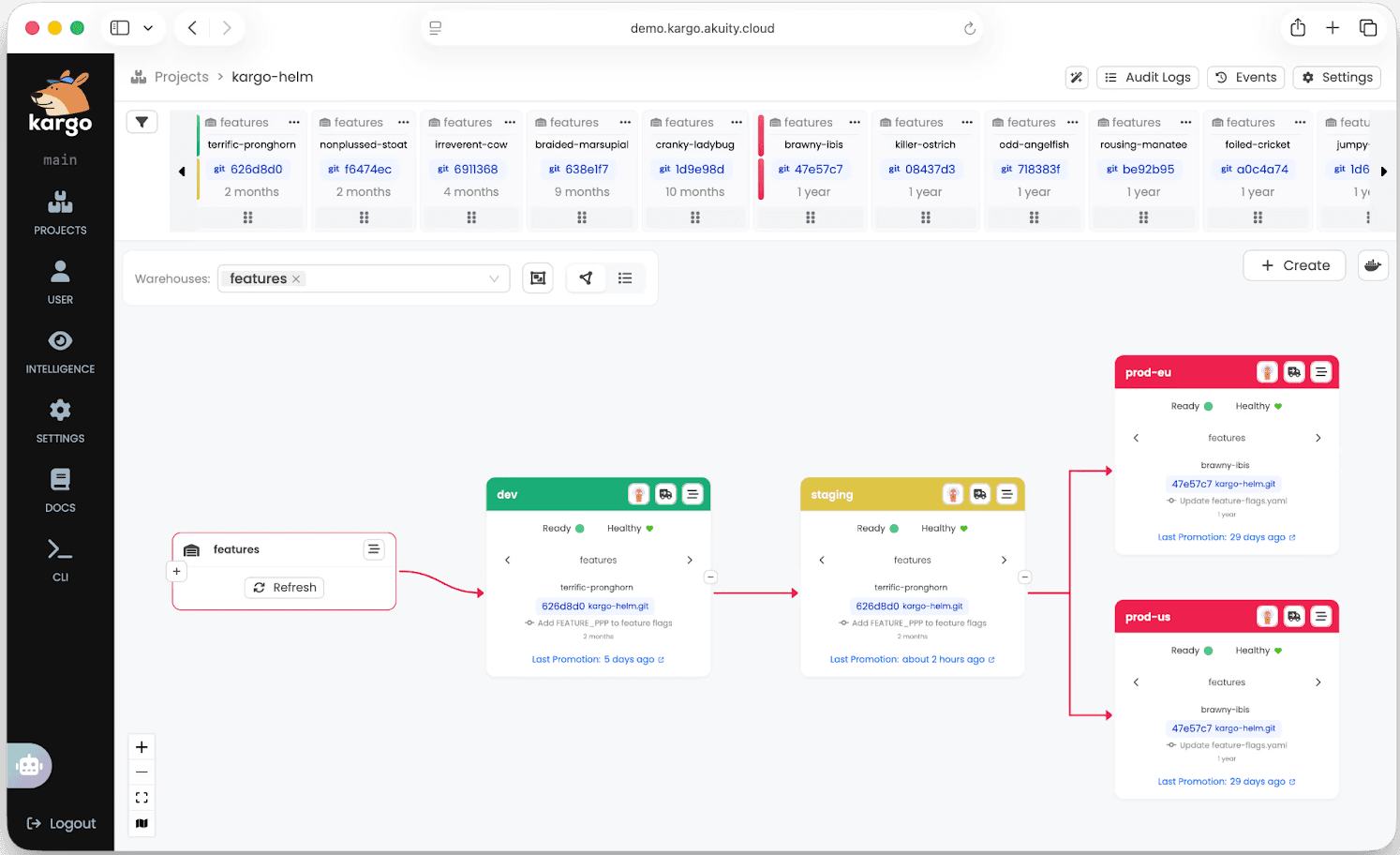
Figure: Multi-Stage Promotion with Kargo
Proof that this model is working is in the growth of the Kargo community.
The Community Behind the Growth
Kargo was created in late 2023 by the same team that built Argo CD, one of the fastest-growing open-source projects at CNCF. That lineage matters. It means Kargo was designed with a clear understanding of how GitOps works in practice, at scale, and under pressure.
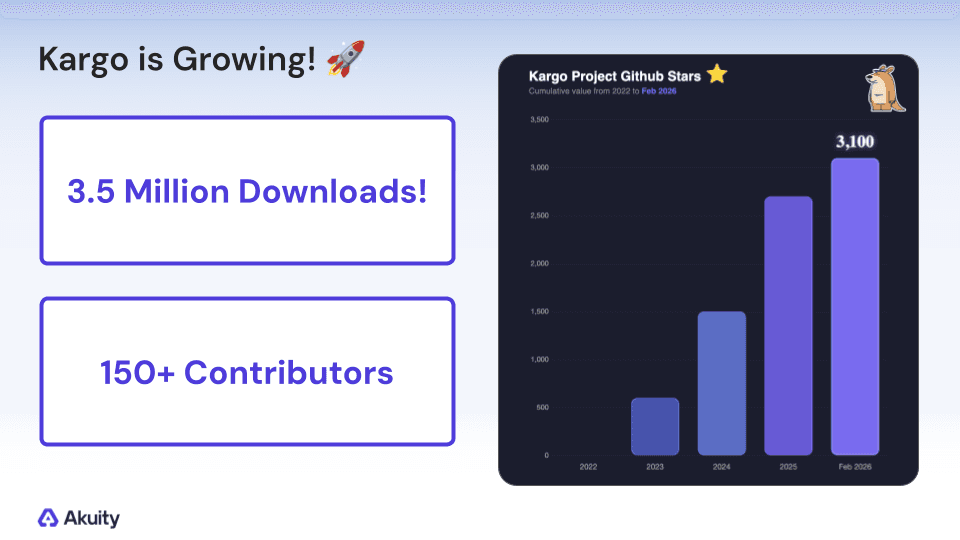
The project now has over 3.5 million downloads, 3,100 GitHub stars (a 50% increase over the past year alone), 160 contributors, and 344 forks. The Discord community is vibrant. New features like label-based app selection, generic webhook support, and Argo CD condition waits all came directly from community feedback. This is evident in recent Kargo releases.
Recent Updates to Kargo
Kargo v1.9 was the most significant release since v1.0. A few highlights:
Infrastructure-aware promotions. Kargo Enterprise now supports Terraform and OpenTofu, bringing infrastructure changes into the same promotion workflow as your applications. A single promotion can now update HCL, run a Terraform plan, apply the configuration, and pass outputs downstream to Kubernetes applications. Infrastructure and application delivery no longer have to be managed in separate systems.
Embedded Argo CD UI. Kargo Enterprise now includes an embedded view of the Argo CD UI, so platform engineers can inspect application state, view diffs, and stream logs without leaving the Kargo interface.
On the open source side, v1.9 also shipped generic webhook receivers, configurable image metadata caching, live log streaming for freight verification, API tokens for programmatic access, and a new REST API designed for long-term compatibility.
These improvements are already being put to work across open source teams and large commercial organisations alike.
Who Is Running Kargo in Production
While many organizations use Kargo in production, we wanted to highlight two standout stories.
Deutsche Telekom runs 500+ microservices across 40 development teams, serving roughly 20 million users per day. Their platform team moved away from classic pipelines to Kargo and Argo CD specifically because pipelines offered no reliable view of deployment state, no reconciliation, and no cleanup. One of the features they found most valuable was rendered manifests: the ability to see the exact YAML that will be applied to a cluster before it gets there, including changes introduced by Helm dependencies that would otherwise be invisible until after deployment.
Cisco ThousandEyes manages 2,500+ applications deployed across multiple clusters and AWS regions. Before Kargo, promoting a release meant opening pull requests environment by environment and manually coordinating updates across clusters. "When you're operating many clusters, it's not easy to know what version is running where," said Nikolay Denev, Technical Lead on the Engineering Effectiveness team.
With Kargo Enterprise, the team replaced manual coordination with automated promotion pipelines that integrate directly with their existing Argo CD workflows. New services are onboarded to Kargo by default, and developers merge a change once and let the pipeline handle the rest. "Before, rolling out a change across all environments could mean opening dozens of pull requests and managing them manually. Now we merge the change and simply watch the pipeline progress."
JumpCloud uses Kargo to orchestrate multi-environment production pipelines with both manual and automatic promotion paths. Releases sit in a production gate until they are either approved manually or an auto-deploy label triggers automatic progression. They use Datadog for verification. Interestingly, JumpCloud also uses Kargo to deploy Kargo itself.
These examples make it clear that Kargo is battle-tested at scale at some of the largest organizations across the world.
Kargo for the Enterprise
Akuity's commercial offering extends the open-source Kargo with capabilities designed for teams running workloads at scale in highly regulated environments. The managed control plane means you do not need to dedicate a cluster to run Kargo itself. The agent-based architecture handles multi-cluster deployments without the scalability limitations of a hub-spoke model.
The enterprise Akuity platform supports vital certifications such as SOC 2, ISO 27001, PCI DSS v4.0, and HIPAA. A dedicated EU region in AWS Frankfurt supports GDPR and data residency requirements. Enterprise integrations cover ServiceNow, Jira, JFrog Evidence, Slack threaded notifications, and secret synchronization across clusters.
ServiceNow integration. For teams in regulated environments, formal change management has historically been a manual step that sits outside the deployment pipeline. Kargo now creates, updates, and waits on ServiceNow tickets as part of a promotion. This uses approvals as gates, and the audit trail is maintained automatically.
The Akuity Platform features AI capabilities: the Promotion Advisor scores promotion risk based on commit history and stage data, and the On-Call agent diagnoses and triages incidents. The Promotion Advisor analyses diffs and deployment history before a release, surfacing a risk summary so engineers know what they are shipping before it goes out.
GitOps and AI
AI is producing code faster than most delivery pipelines were designed to handle. As that pressure increases, the promotion layer becomes even more important. Hong Wang, co-creator of Argo CD and Kargo, put it plainly at DevOps Live London earlier this year: "In the AI era, GitOps becomes more foundational. Everything will be code, everything will be declarative, and everything will be managed that way."
Kargo is the system that makes this possible in practice, giving platform teams the control, visibility, and auditability needed to keep up with faster release cycles without sacrificing governance.
See You in Amsterdam
The Akuity team will be at KubeCon + CloudNativeCon Europe 2026, March 23-26 at RAI Amsterdam. If you want to see Kargo in action, talk to the people building it, or compare notes with practitioners running it in production, this is the place to be.
Sessions to mark on your calendar:
March 23, ArgoCon: "From Kubernetes to Anything: The Evolution of Promotion with Kargo" — Jesse Suen, Akuity (Sponsored Keynote)
March 23, ArgoCon: "Agnostic Workload Identity Across the Argo Ecosystem Using SPIFFE and SPIRE" — Blake Pettersson, Akuity
March 23, ArgoCon: "A Contributor's Guide to Argo CD Local Dev" — Nitish Kumar, Akuity (Lightning Talk)
March 24-26, KubeCon: "The 10x DevOps Engineer's Toolkit: Argo CD + AI-Driven MCP Automation" — Alexander Matyushentsev, Akuity
March 24-26, KubeCon: "Tell Us How You're Using Argo CD: A Community ContribFest Session" — Alexander Matyushentsev, Akuity
Even if you’re unable to make it to Amsterdam, you can start exploring Kargo today. Head over to GitHub for the open-source version, and start your free trial of the Akuity Platform to experience enterprise-grade Kargo.
