What is the Argo Project? Argo CD, Workflows, Rollouts, and Events Explained
Daniel Hoang

Originally published September 23, 2025. Updated on August 13, 2026.
TL;DR
The Argo Project is a popular CNCF-graduated project with four tools, each solving a distinct gap in Kubernetes' deployment, orchestration, and automation layers.
Argo CD is the natural starting point for most teams: it keeps cluster state synced to Git and holds the largest adoption of the four, with almost 24K GitHub stars.
Argo Workflows earns its place once jobs need fan-out/fan-in orchestration, not general deployment: it's the go-to for data and ML pipelines.
Argo Rollouts becomes worth adding once release risk is the actual bottleneck: it replaces Deployment with blue-green and canary strategies plus automated rollback.
Argo Events is the smallest and most specialized of the four: worth adopting once event-driven triggers, not scheduled jobs, are the real need.
Kubernetes has become the standard for running containerized applications at scale: the CNCF's 2026 Annual Cloud Native Survey found that 82% of container users now run Kubernetes in production, up from 66% in 2023. Kubernetes handles how workloads get scheduled, scaled, and kept running across a cluster. But it doesn't define how changes get deployed, rolled out safely, orchestrated across multi-step jobs, or triggered automatically from external events. The Argo Project fills these gaps with a set of interoperable, Kubernetes-native tools: Argo CD, Argo Workflows, Argo Rollouts, and Argo Events.
What Is the Argo Project?
The Argo Project is CNCF-graduated, meeting the foundation's standards for adoption, governance, and sustained contribution, and holds its own co-located event, ArgoCon, alongside KubeCon each year.
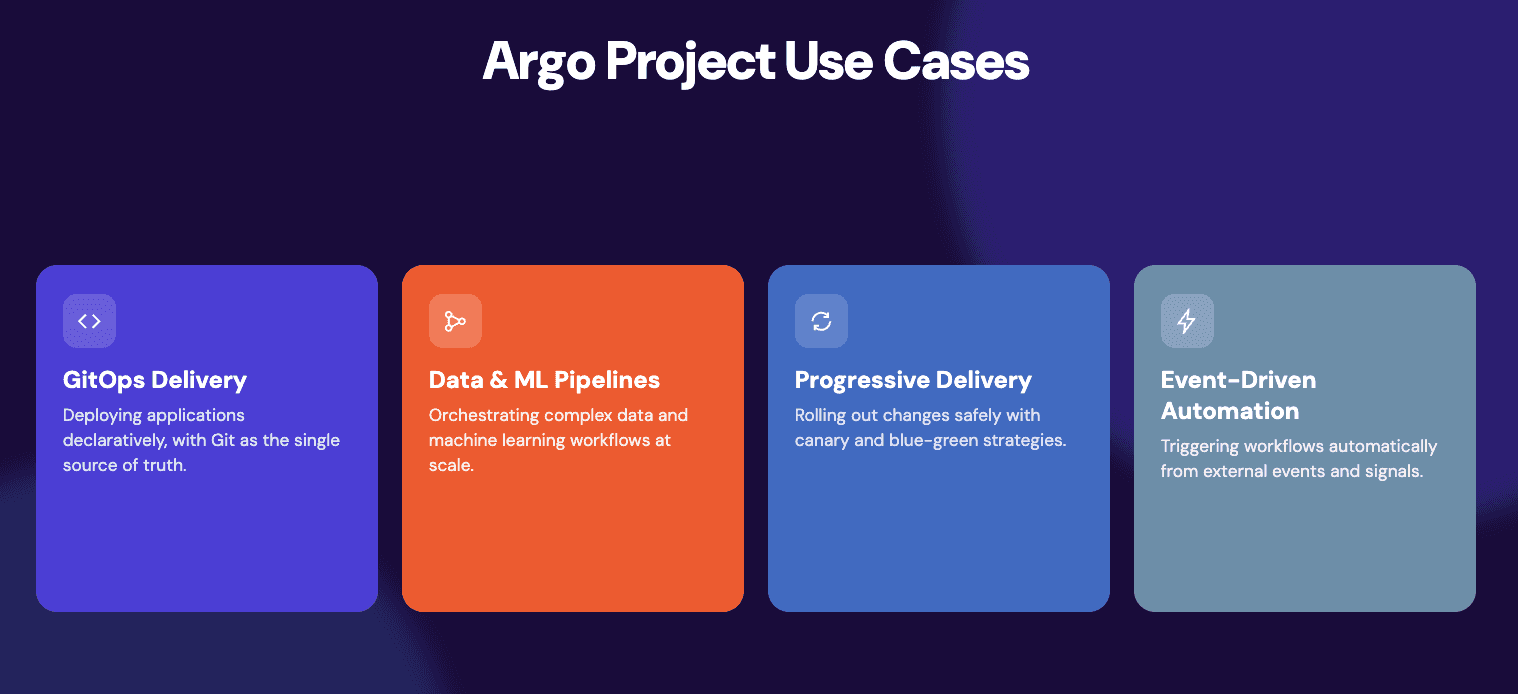
The Argo Project's reach across the entire software delivery lifecycle is what sets it apart from single-purpose tools: teams use it for deploying applications via GitOps, orchestrating data and ML pipelines, rolling out changes with canary or blue-green strategies, and triggering automation from external events.
Hong Wang, Jesse Suen, and Alexander Matyushentsev originally built Argo Workflows in 2017 to orchestrate containerized jobs on Kubernetes. Argo CD, Rollouts, and Events followed as separate tools over the next two years. The following sections cover what each one does and how they fit together.
What Are the Core Components of the Argo Project?
The Argo Project includes four tools that each address a different challenge in deploying and operating applications on Kubernetes:
Argo CD for declarative, GitOps-based continuous delivery
Argo Workflows for orchestrating complex container-native jobs
Argo Rollouts for advanced progressive delivery strategies
Argo Events for event-driven automation across your Kubernetes stack
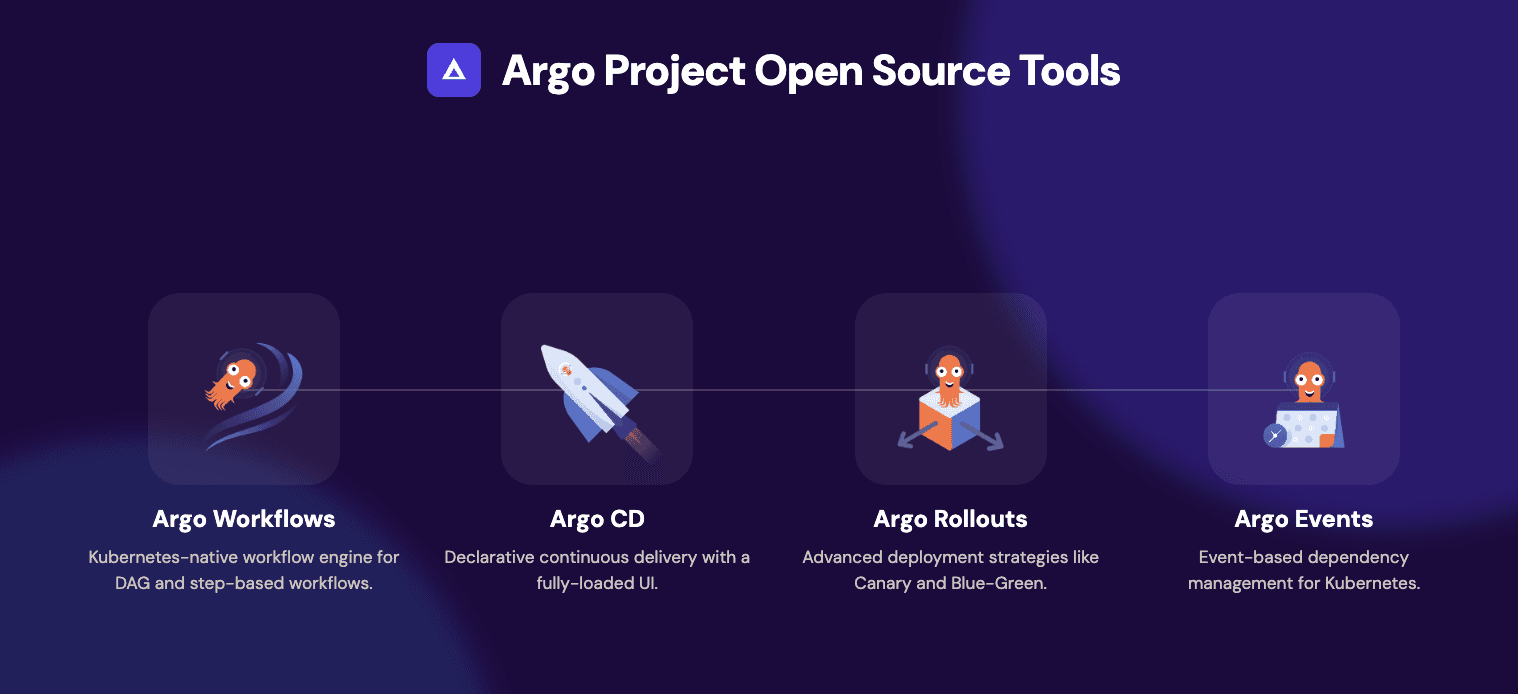
Table: GitHub star counts as of August 3, 2026.
Tool | Description | Primary Use Case | GitHub Stars |
Argo CD | Keeps Kubernetes cluster state synchronized with a Git source of truth | Continuous delivery and drift detection | 23,821 |
Argo Workflows | Extends Kubernetes with a Workflow resource for multi-step, container-native jobs | Data processing and ML pipelines | 16,866 |
Argo Rollouts | Replaces the native Deployment resource with progressive rollout strategies | Canary and blue-green production releases | 3,539 |
Argo Events | Triggers Workflows or any Kubernetes resource from external events | Event-driven automation across the stack | ~2,700 |
Argo CD and Argo Rollouts are the two most commonly paired together in production, since deployment sync and progressive rollout strategies naturally work in sequence.
#1: Argo CD: GitOps Continuous Delivery for Kubernetes
Argo CD was built at Intuit to solve a specific problem: migrating from physical data centers to Kubernetes on AWS at enterprise scale, under financial-services regulatory and compliance requirements. A GitOps approach satisfied these requirements, but the tooling hadn't been built yet. Creators Hong Wang, Jesse Suen and Alexander Matyushentsev built Argo CD as a Kubernetes-native controller that keeps cluster state synchronized with a Git source of truth.
Argo CD is typically used for infrastructure and application deployment across one or many clusters. For the mechanics of how it detects drift, synchronizes state, and structures its control plane, see What Is Argo CD? How GitOps Sync and Drift Detection Work.
Argo CD in brief: Git-based drift detection and sync, runs in nearly 60% of Kubernetes clusters per the 2025 Argo CD End User Survey, pairs with Kargo for cross-environment promotion.
#2: Argo Workflows: Orchestrating Container-Native Jobs on Kubernetes
Kubernetes didn't yet provide a native way to orchestrate multi-step, parallel jobs. At Applatix, later acquired by Intuit, creators Hong Wang, Jesse Suen, and Alexander Matyushentsev built Argo Workflows as a Kubernetes custom resource, in which each step runs as its own pod, allowing multi-step pipelines to run natively on Kubernetes rather than through a separate orchestration layer.
Argo Workflows is commonly used for data processing and ML pipelines with fan-out/fan-in patterns; Ant Group and CERN both run it at scale for data processing, and it has increasingly replaced tools like Apache Airflow for Kubernetes-native pipelines.
Argo Workflows in brief: pod-based workflow steps, fan-out/fan-in job orchestration, used in production by Ant Group and CERN.
#3: Argo Rollouts: Progressive Delivery for Kubernetes
Kubernetes' native Deployment resource has no built-in support for blue-green or canary rollout strategies. At Intuit, creators Jesse Suen, Alexander Matyushentsev, and Danny Thomson built Argo Rollouts as a Rollout resource that replaces Deployment, adding those strategies natively along with service mesh and ingress integration to shape traffic during a release.
Argo Rollouts automates promotion and rollback based on configurable analysis, making it production-ready for gating releases against real-time metrics rather than rolling out changes blind.
Argo Rollouts in brief: blue-green and canary strategies, service mesh and ingress integration, automated promotion and rollback based on metric analysis.
#4: Argo Events: Event-Driven Automation for Kubernetes
Kubernetes lacked a lightweight, native way to trigger resources or Argo Workflows automatically in response to external events. At BlackRock, engineers built Argo Events as a framework that triggers Workflows or any Kubernetes resource from commits, messages, or scheduled events, then donated it to the Argo Project.
Argo Events covers use cases from simple trigger-on-result automation to complex ML and data-centric pipelines that depend on multiple upstream events completing before running.
Argo Events in brief: triggers Workflows or any Kubernetes resource from commits, messages, or scheduled events; supports both simple triggers and complex multi-event dependency chains.
The Origin Story for the Argo Name and Mascot
The Argo Project's octopus mascot has a unique origin, tied to Greek mythology and marine biology. Jesse Suen, Argo Project Lead and Akuity Co-founder, explains the inspiration for the name:
"When we started working on the Argo Project, we needed a name. In Greek mythology, Argo was a ship that carried Jason and the Argonauts on their quest for the Golden Fleece. An argonaut is also a species of deep-sea octopus known to be a hard-working species and to play an important role as both hunter and hunted in the deep-sea ecosystem, and so we used an octopus as our open source project mascot."
Where Akuity Fits: Deploy, Promote, and Operate
Akuity was founded by the creators of Argo CD and Kargo. The Akuity Platform covers three stages of the path above: deploy with Argo CD and the Deployment Advisor, promote changes across environments with Kargo and the Promotion Advisor, and operate with Insights Dashboards and the On-Call Agent. An agent in each cluster keeps credentials inside the cluster and spreads controller work per cluster instead of concentrating it in one instance.
Additional Argo Project Resources
How to Automate Blue-Green & Canary Deployments with Argo Rollouts
Masterclass: Advanced Argo CD Application Configuration Patterns
Master Class: Getting Started with GitOps — Argo CD Projects
Continuous Promotion with Kargo: A Platform Engineer’s Guide
FAQs About the Argo Project
Q: What is the Argo Project in Kubernetes? A: The Argo Project is a collection of CNCF-graduated tools built to simplify Kubernetes-native continuous delivery, workflow automation, progressive delivery, and event handling.
Q: What's the difference between Argo and Argo CD? A: Argo refers to the full ecosystem of tools. Argo CD is a specific component that handles continuous delivery using GitOps principles.
Q: Does the Argo Project include Kargo? A: No. Kargo is a separate open-source project, also built by the Argo CD team, that manages promotion of changes across environments and clusters. It's designed to pair with Argo CD.
Q: Can I use Argo tools separately? A: Yes, each tool (Argo CD, Workflows, Rollouts, Events) can run independently, and many teams combine two or more as needs grow, for example pairing Argo CD with Argo Rollouts for progressive delivery.
Q: Is Argo only for advanced Kubernetes teams? A: No. Argo Rollouts and Argo Events support advanced use cases, but Argo CD's UI gives teams new to Kubernetes and GitOps a way to see what's deployed without needing deep command-line fluency first.
